Blog · C10
One integrated platform vs. a zoo of point tools: where the hidden cost is
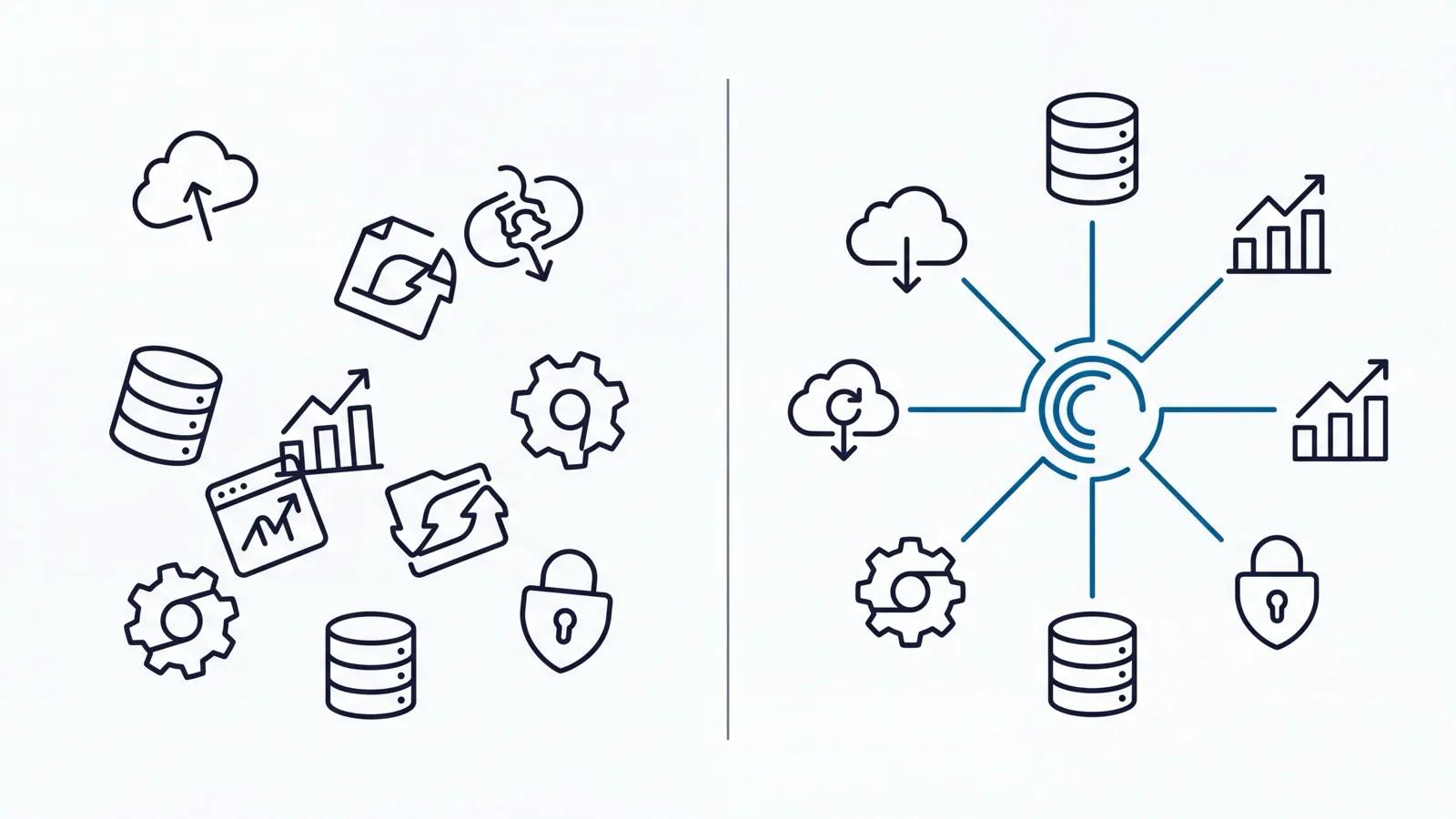
The hidden cost of running separate tools for documents, quality, projects, HR, and knowledge is not the license fee for each one — it is the integration work nobody budgeted for, and the 71% of enterprise applications that never get properly connected in the first place.
The scale of the sprawl
The average company now runs roughly 275 SaaS applications; large enterprises run around 660, and 46% of organizations report 1,000+ applications in use (Zylo SaaS Management Index, 2025). Industry analysts estimate that 71% of applications in an average enterprise remain unintegrated (2025 integration-market analysis). That is not a rounding error — it means most of an organization's software estate is a set of separate records that never reconcile with each other automatically.
Where the cost actually lands
Tool sprawl's cost is not the subscription line. It shows up three ways:
- Financial impact reported directly. 87% of IT leaders say tool sprawl has a "moderate to major" financial impact, with up to a third of IT spend estimated as wasted (2025 IT-leadership survey). Mid-market firms report roughly $2.3M in annual losses from software redundancy, productivity loss, and support overhead (2025 mid-market IT analysis).
- Productivity lost to reconciliation. A 10-person mid-market IT team's productivity loss from sprawl is estimated at the equivalent of two to four full-time employees per year (2025 mid-market IT analysis) — time spent moving data between systems that don't talk to each other, not doing the work those systems exist to support.
- Re-keying at every handoff. When a document-control system, a quality system, a project system, and an HR system don't share one identity and access model, the same fact (a client name, a document revision, a competency record) gets typed in more than once — and drifts every time it does.
Why consolidation is accelerating
Organizations are responding: consolidation rates have roughly doubled, from 14% in 2023 to 33% in 2025 (2025 SaaS-management survey), and 77% of technology decision-makers report moderate to extensive sprawl with 63% actively pursuing consolidation (2025 Forrester-sourced survey). The direction of travel is away from "best-of-breed everywhere" and toward fewer systems that already share data.
What "one platform" actually removes
Efixera's design principle is a shared substrate — one identity/access model, one file store, one approval-workflow engine, one audit trail — under seven module families (documents, quality, lab, HR, library, projects, pre-contract). The point is not that one vendor is inherently better than seven; it is that a document referenced from a project, a competency record checked against a hazardous work assignment, or a failed lab test that should raise a non-conformance are the same fact resolved through one Integration Bridge, not four separate exports and imports.
Concretely, this removes:
- Duplicate identity — one login and one access model instead of provisioning (and de-provisioning) accounts across every tool.
- Manual re-keying at handoffs — a lab-test failure raises a quality non-conformance automatically; a won pursuit opens the project without re-typing the client and contract.
- Reconciliation work — one audit trail across modules instead of stitching together exports from separate systems before every audit.
FAQ
Doesn't a single platform create its own lock-in risk? Data ownership and export are explicit
design commitments (documented on /trust), specifically because point-tool sprawl and platform
lock-in are the same underlying risk — dependence without control. The difference is that
consolidation is a choice made once, deliberately, rather than an accumulation of a thousand small
tool decisions nobody tracked.
Can we adopt this module by module instead of all at once? Yes — each module stands alone and gains additional value as adjacent modules are added on the same login and access model; there is no requirement to migrate everything on day one.
Sources
- Zylo, "2025 SaaS Management Index."
- 2025 enterprise-integration market analysis (application-integration rate).
- 2025 IT-leadership tool-sprawl financial-impact survey.
- 2025 mid-market IT productivity-loss analysis.
- 2025 SaaS-management consolidation-trend survey (14%→33%).
- 2025 Forrester-sourced technology-sprawl survey (77% / 63%).