Blog · C14
From opportunity to handover without leaving the platform
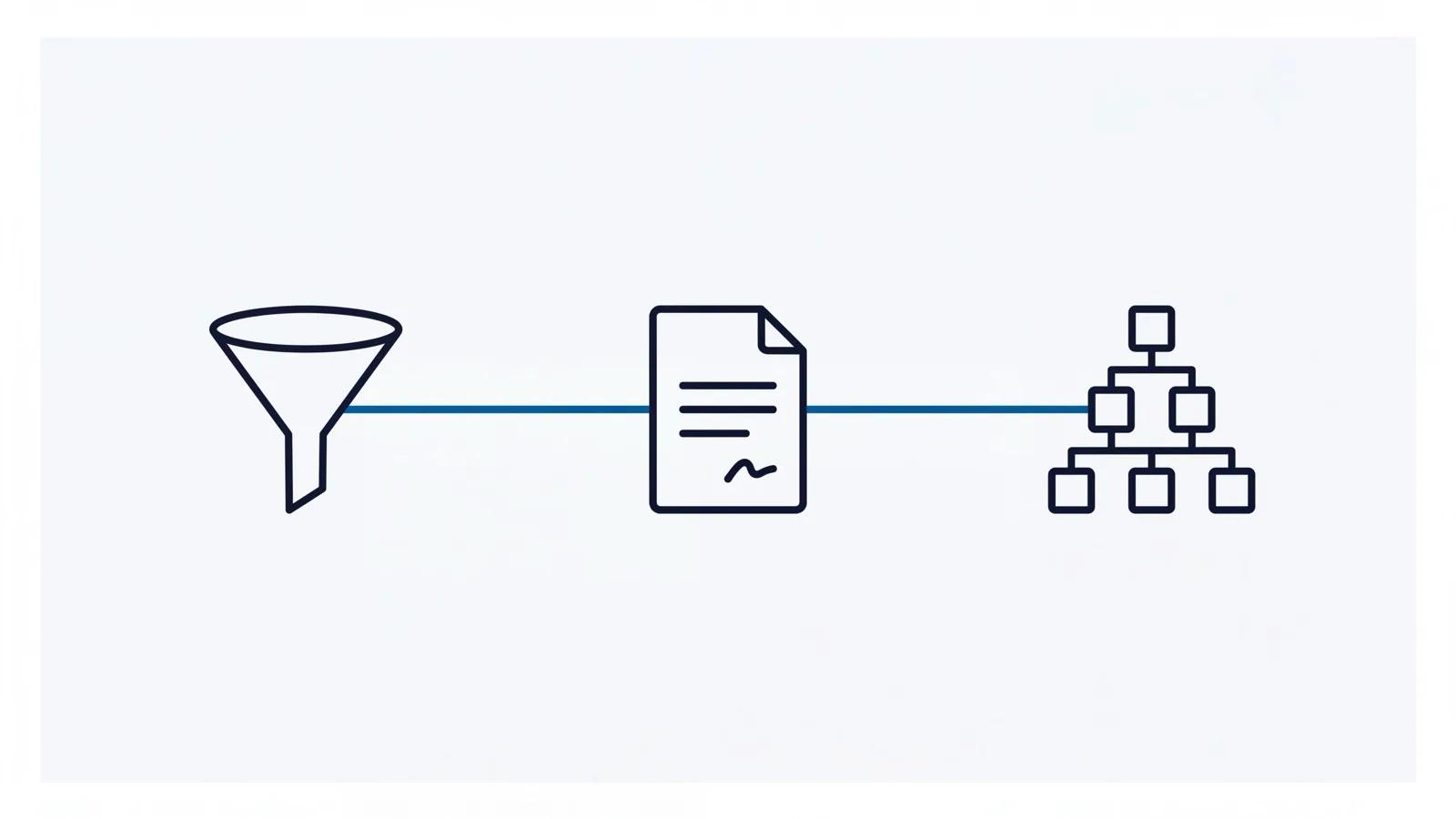
A won opportunity that opens its project automatically — carrying the same client, contract, and scope record from bid to execution — eliminates the re-keying step where a pursuit's information gets lost or re-typed by hand on the way into delivery.
Where the funnel usually breaks
Pre-contract work (opportunity intake, bid evaluation, proposal, contracting) and project execution are typically run in different systems, or in no system at all for the pre-contract half. The practical consequence: by the time a contract is signed, the organization cannot see its own pipeline — how many pursuits are open, what they're worth, what fraction convert — and when a pursuit is won, someone re-enters the client, the contract terms, and the scope into whatever system runs the actual project. Every re-entry is a chance for the two records to disagree.
The proposal-management software category — the tools organizations already buy to manage the bid side of this problem in isolation — is valued at roughly $3.2B in 2025, growing at 11.1% CAGR (Future Market Insights, 2025), a crowded market of tools that each solve one slice, most without a built-in path into project execution.
What a single funnel looks like end to end
A structured pre-contract funnel moves an opportunity through seven gates:
- Opportunity Intake (O1) — client request registered, classified, number-generated.
- Bid Evaluation (O2) — technical review + bid/no-bid scorecard, recorded.
- Scope Approval (O3) — detailed scope review, clarification register (technical queries tracked Issue → Query → Response → Resolution → Closure), applicable-standards register.
- Commercial Approval (O4) — pre-bid discipline-based man-hour estimate, commercial proposal, an approval chain (Department Manager → Technical Director → Finance → Executive), submission, negotiation.
- Contracting (O5) — contract drafting, parallel review (Legal/Finance/Technical/Executive) with redline and version control, e-signed execution.
- CPE Assignment (O6) — the project's future lead is selected, with a workload and competency check against the HR system before assignment.
- Handover (O7) — the won opportunity opens the contract and project in the execution system directly, with the opportunity and project linked for traceability.
Why the handover step is the one that matters most
Gate O7 is where most organizations lose data quality: the client, the contract terms, and the scope that were carefully tracked through six prior gates get re-typed from a mailbox into a separate execution tool, and small transcription differences accumulate. A direct handover — the same underlying client and contract record simply becoming visible to the execution module, linked rather than copied — removes that step entirely. The project starts with the actual negotiated contract, not someone's memory of it.
What this makes measurable
Because every pursuit sits in one register from intake, an organization can finally see:
- Pipeline value and count, aged, at any point in time — not reconstructed from email searches.
- Conversion rate: won versus submitted proposals, tracked over time.
- Where pursuits are lost, tied to a stage (technical fit, price, schedule, relationship) rather than an untracked "no."
FAQ
Does this require replacing our existing CRM? The scope here is the pre-contract-to-handover funnel specifically — opportunity through contract execution and project opening — not general customer-relationship management. Organizations already running a broader CRM can evaluate this as the bid-to-contract layer that's typically missing from it.
What happens to the clarification history after handover? It stays attached to the opportunity record, linked to the project it became — so if a technical query from the proposal stage becomes relevant during execution, it's traceable back to its original resolution rather than re-litigated.
Sources
- Future Market Insights, "Proposal Management Software Market," 2025.